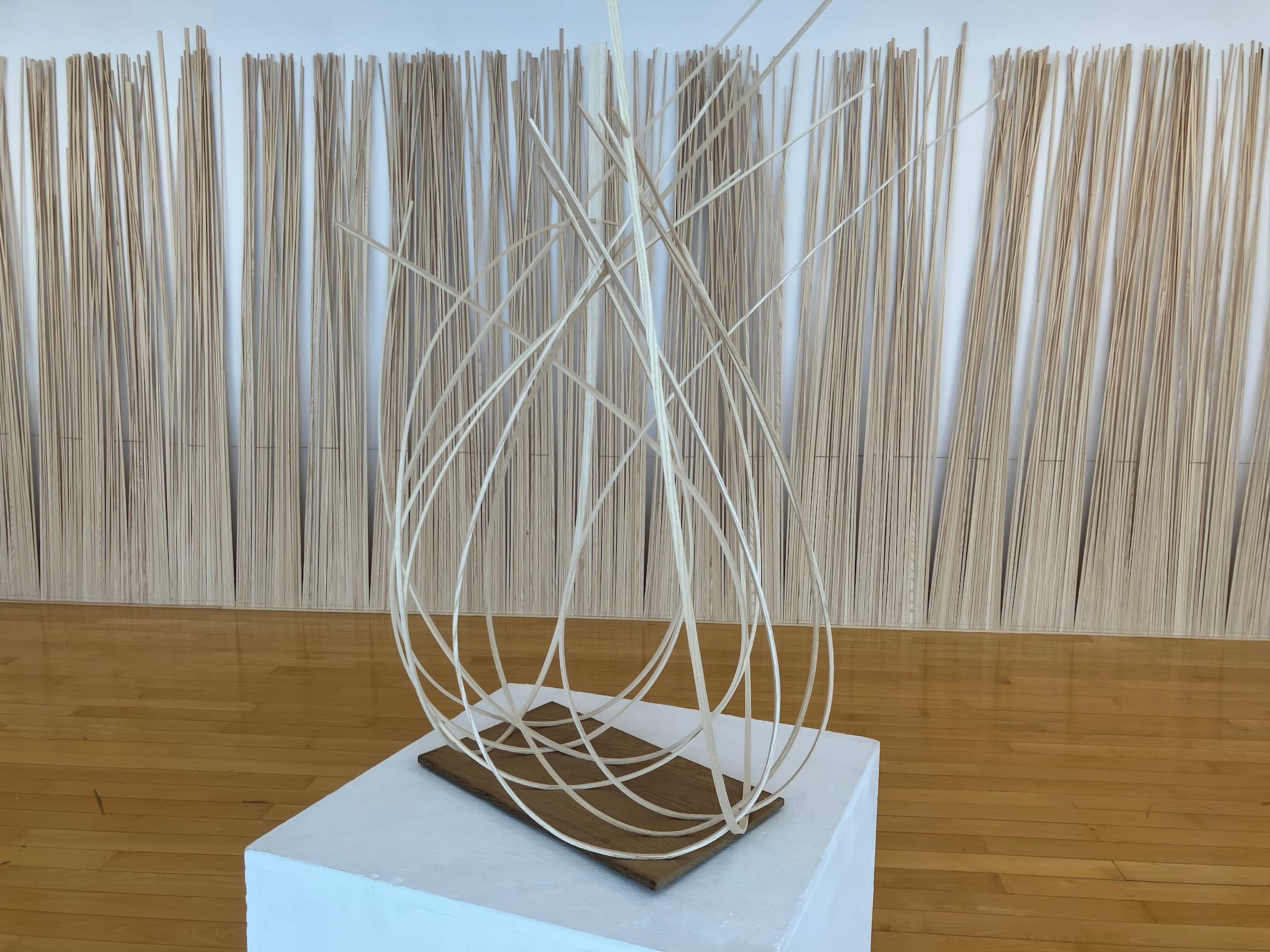
No matter how much our tecnomorphic civilization unconditionally aims for progress, in the scientific understanding of the world, its "dark shadow" is always turned towards the source, beginning, origin of all reality. Pre-Socratic thinkers among ancient Greeks coined a term for this that signifies so-called basic structure or proto-matter, the root cause of which nature is made, and called it arché (ἀρχή). The archaic is therefore always contemporary, and antiquated irrelevant or unrelated to present. This fatal relationship between first and last, in the metaphysical sense, is perhaps nowhere as evident as in the case of contemporary art, which, unlike gone by epochs, remains indeterminate like that character from one of Kafka's parables who stands still because he cannot go forward nor back. Although it seems that "today", in demise of post-avant-garde aesthetic tendencies, painting is the ruling medium of returning to artistry still important for modernism, with its demand for joining the beautiful and sublime, faced with apocalypse, chaos and anxiety of human existence, all the way from Picasso to de Chirico, it is significant that, despite dematerializing the world in the age of Technosphere, resistance to this dehumanization and loss of physicality is increasingly at work in contemporary architecture and sculpture. Forms cannot be produced without knowledge of the first beginnings and proto matter. In the case of a contemporary witness to this bond between the term arché and the state of complex balance between system and environment in which nature and human meet, Krešimir Katušić’ artworks surely deserve more than critical attention from interested observers. Moreover, they pose a challenge in the paradoxical reversal of the power of tradition, becoming a kind of redirection of perception in which, just as Paul Klee demanded in one of his diary entries, the very artwork now observes and analyses its viewer.
New works of the sculptor Krešimir Katušić iconoclastically bring together aestheticization of wood in a framed space, beyond traditional understanding of opposites - figuration and abstraction. In this way, they seem to become ornamental, since them being on display calls into question the relationship between natural and artificial on the border of art and its use function. Katušić established sculptural rationalism practicing metamorphosis of wood as his own hologram in which he inscribes hidden and evident meanings of the elemental, in a state of complex balance, against the already seen set of played out 'innovations' and 'experimentalities'. It is not a random process by which the reflexive and the instinctive in woodcarver's departure from his own time strives to be grounded in really deep insights into classical art cosmologism and archetypes, as Peter Sloterdijk and Hans Jonas, at the end of the 20th century, brought back to the centre of attention, pursuing the idea of image and homo pictor in the history of Western metaphysics (see Žarko Paić: Aesthetics and the Iconoclasm of Contemporary Art: Pictures Without a World, Springer International Publishing, Cham, 2021.) Practicing authorial metamorphosis of wood, Krešimir Katušić dissolves its core, thus creating a branching of lines as an interweaving. If we keep in mind how new key categories - such as contingency, emergence and singularity - appear both in modern science theory and philosophy, for example by Gilles Deleuze, it becomes clear why in Katušić’ works we witness reflection of the emergence of "new", not as repetition of the same, but as exceptions in the process of becoming other and different.
Arhé is not only a mystery of how the world comes into being, in the act of a primordial idea that appears in form, matter and energy potential. The real mystery is in the occurrence of chance as necessity by which form and matter are constantly changing, while remaining the same. Hence, sculpture, as well as the architecture of ancient civilizations that shaped their religious and profane buildings in wood, such as Polynesians and people from Japan, represents a metamorphosis of change resulting from the circular movement of planets and the Earth. Destruction of things is inscribed in their illusion of permanence. Everything that wood enables the artist today is not fundamentally different from original works of first peoples and their committed artists-artisans, with something inherent to contemporary art. That something is necessarily experimental nature of the performance medium, which has its own history which cannot be reduced to the world history of West. What is more, the polymorphic nature of woodcarving and sculpture points to two complementary things in essence of producing forms. One is aspiration towards ideal harmony between nature and the surrounding world, inhabited by mythical peoples who considered the archaic to be ever present and man to be guardian of this cosmological balance. The other is contemporary tendency to establish balance as a complex field of interdependence between what belongs to tradition and what is contrary to it, like our furious time of techno morphosis, thanks to scientific constructions and transformation of world into technological singularity. The wood that Krešimir Katušić processes meticulously and with analytic precision is by no means a neutral medium of his creativity. Just as for a violin maker, so for the artist, the entire process of drying, supervising the process of giving matter form, into what the sculptor metamorphically brings to expression, almost has an occult meaning, because wood lives and breathes, suffers and enjoys its own transformation, like any other living being, for which applies what composer Gustav Mahler claims, in a letter to Alma Mahler, that even stones long for other stones and feel love vibrations, suffering when oppressed or humiliated.
Katušić' selected wood artefacts presenting him in this one, after two successful exhibitions at Orisa gallery and Filakovac gallery in Zagreb, last year and this year, certainly show three key cognitive-aesthetic turning points in his understanding of the essence of contemporary art as part of retro-futurism and neo-traditionalism. These are:
(1) Persistent analytical homage to mastery as perfecting art of woodcarving in all aspects of this ancient, archaic topology of myth and event, by which art appears in the world as a mystery of what made objects emanate to observers, observing them like animate objects in their surroundings;
(2) Inexpressibility that emanates from his works, so fluidly and fractally in spatial reliefs of geometric figures, such as circles and squares in the painting, leads to strange tranquillity and discomfort. This is truly mastery of pure sculptural tautology which says and shows nothing, but only points to and marks what happens in the pictorial turn between object and its observer;
(3) Openness to constant metamorphic work process, by which artwork cannot any longer be presented as fixed and permanent, but constantly changes in its new possibilities of performance and the perspective of observer’s view.
Krešimir Katušić is a sculptor who allows his objects-paintings-artifacts to exist (in space) only in interaction with Other’s gaze. In themselves, they are like their arche, like dark matter about which we know little, and what we do know is still "dark" and cannot be expressed. Wood is not only alive and pulsating. It is also a simulacrum of complex balance in which we live "today", between aspiration for tranquillity of tradition and frantic will for dizzying speed of transition into complete dematerialization. There is a third option and it comes from art as a state between conflicting opposites, including the attempt to stop time in its primordial spatiality.
Share


 Copied

Krešimir Katušić is a contemporary Croatian artist known for his work in the medium of image, sculpture and installation.


Copyright © 2025 Krešimir KatušićWebsite by SP Studio