In a society governed by the particular value differentiation principle, the individual rights apology and the imperative of self-realisation, each invocation of cultural universalism seems naive, to say the least. Art is no exception to this, since the most recent universalisation paradigm, the modernist one, according to which art should represent the sum of the values around which a general consensus could be built regardless of social differences, has not represented for a long time a horizon within which art is created, understood and valued. The system in which the artistic activity is globally formed is rather liberal and pluralistic as it used to be so far; it is not just that the artistic message can have a media appearance of any kind, but its media appearance can be found at the level of its conative function, which is a function focuses on the message recipient and art is aimed at becoming the centre of ideological and political differentiation, racial and gender profiling, with all kinds of social distinction. Within such a pluralist environment, everyone can find something for themselves and this is probably the only normative determinant of art today.
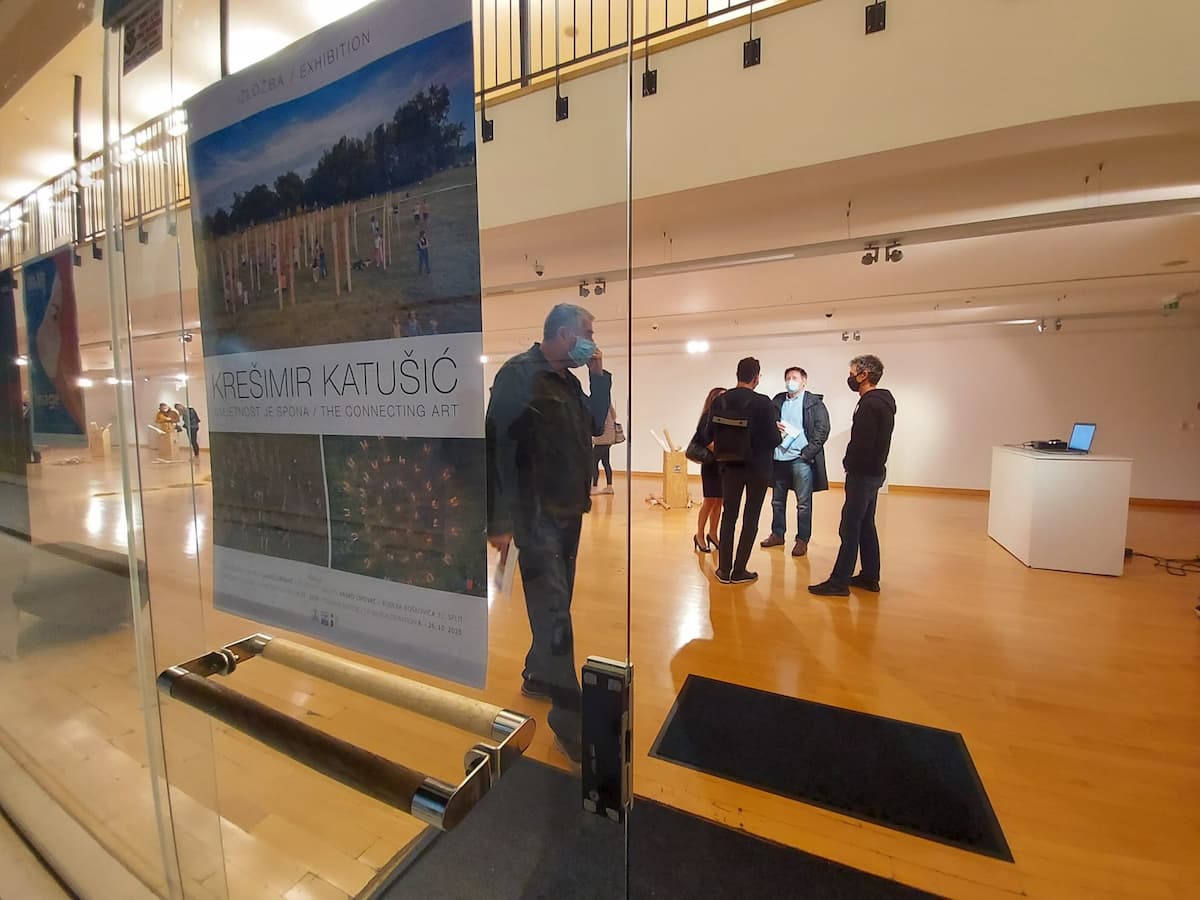
From this very perspective, the approach of Krešimir Katušić to his own artistic practice, as well as to art in general, clearly stands out among the conjunctural. Namely, the experience that Krešimir Katušić is seeking to invoke, to mediate, it imposes itself at a glance as belonging to the human species. The focus on the anthropological understanding of creativity as an elementary human need, ecologically coherent with the generative processes of the world and the universe as a whole, forms a consistent narrative framework for storing all the created works and projects. Although they differ in terms of their shape and medium, they have a fundamental poetic principle in common, which is the principle of allegory. For a predetermined or targeted narrative, Katušić seeks and finds clear metaphorical forms – all of which are recognisable or concise in the associative way and lose their denotative, relevant meaning in new constellations, becoming holders of a specific abstract plot. Tension between the absolute speculation of the identified content and simplicity, ordinariness and specificity of the signs used is typical of the allegorical mindset that Katušić chooses deliberately. It does not take too much thinking or specialist knowledge for the form of scrolls or rotuli to be recognised as a symbol of ancient knowledge or to read the story of the loss of such ancient knowledge and a mythical oblivion of universal consciousness in scattered letters and the loose composition of scrolls. The shape of a human fetus, an unborn human, unequivocally conveys the idea of conception and creation of new life, as the spiral pattern of these forms suggests the principle of an infinite development of all the forms of life from a common centre, the principle of a constant growth and renewal. The analogy of such a poetic principle can be seen in the video-film entitled Nexus (cro. Spona), as well, although it has got a narrative form and the film functions as a metalinguistic supplement to other literary works, presenting a related way of storytelling. The film is about an 'elusive' emotional experience of the artistic creation, psychophysical processes of creative behaviour and activity, but it does that exclusively through the testimonies of the individuals dealing in various forms of art and spirituality, the individuals from our own environment. These people are not experts in the field of Art Theory, Psychology or Anthropology, but various practitioners sharing their knowledge and experience acquired through his own efforts and self-observation. They use an informal language, speaking in a natural way. They were filmed in their own homes and workplaces, answering always the same question that was deliberately omitted in the film itself. The film ends with an event, a sort of happening, an organised social gathering of people invited to participate in the finalisation of an outdoor spatial installation, made of megalithic wood boards, arranged in a circle in order to suggest a spiral expansion movement. The film portrays the people who look relaxed while working on 'their' part of the installation, hanging out at the same time and playing their part in the ceremony that clearly celebrates the idea of unity in diversity. The poetics of the film, therefore, is based upon speaking in images, with this abstract topic being presented through the first-person speech, through an intimate, confessional statement of an individual, as well as through symbolic and ritual events.
The artwork of Krešimir Katušić must be recognised and valued as it conveys the message in symbols and concrete and pregnant visual metaphors, meaning that using such metaphors he addresses the topics that art shares with some other areas of human cognition, such as phylosophy, anthropology, psychology and religion. Contrary to the prevailing stereotype, according to which such an artistic approach is necessarily considered to be hermetic, that is, inaccessible and exclusive. Katušić firmly believes that art is the right place to talk and share this knowledge, universal in terms of its tendency, and that it takes a basic knowledge of the culture code, as well as the fundamental goodwill towards the others and the different to participate in such a communication. Within a contemporary artistic environment, where it is getting ever more difficult to address such topics, where distrust of universalist narration, including the one about art as a universal language of the mankind results in the abandonment of the ethical principle according to which the artistic message is conveyed appropriately, adequately or, as Giorgio Agamben would say, it does not address everyone, but anyone, regardless of his, her or their particular characteristics, that is, of them independently, so, in this very environment the position of Katušić is certainly brave.
As a polyvalent artist, Katušić defends his position in different creative situations. He tends to include other collaborators and create a platform for discussion and exchange of opinion in his projects that, as it can be seen from this exhibition as well, do not include only sculptures. Due to his essentially explorative heuristic approach, his works which are always open to further development do not stay still in their current state, but develop over time, acquiring new elements, and easily adapt to new spaces and social environments, passing from one medium to another, combining the stylistically and aesthetically heterogeneous, which may be confusing for those unacquainted with them. It is through this very extensibility that Katušić is testing the universality of the symbolic system and the pictorial language he has devised, willing to take risk, willing even to endure failure in an attempt to reach different people, and not losing sight of the guiding principle we are not willing either to abandon, stating: art is the nexus binding together the multiple faces of the universe.
Share


 Copied

Krešimir Katušić is a contemporary Croatian artist known for his work in the medium of image, sculpture and installation.


Copyright © 2025 Krešimir KatušićWebsite by SP Studio